Archive

Posts Tagged ‘KJV Onlyism’

KJV Only Deception

May 1st, 2009 507 comments

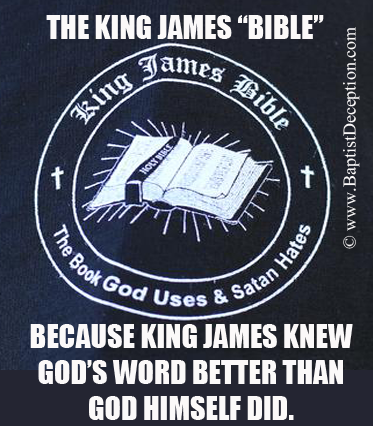
As many of you already know the Independent Fundamental Baptist Movement (henceforth IFB) is a King James Version only denomination meaning that they believe that the King James Version of the Bible (henceforth KJV) is the only version of the Bible that Christians of this era should use. They believe that the KJV is the version of the Bible that is closest to the original. As with other areas of the IFB belief system, this falls along a continuum of beliefs. On the more liberal side of the continuum, some IFB churches believe that the KJV is the most accurate version of the Bible and should be used by all Christians to avoid heretical views and beliefs. On the more conservative side of the continuum, some IFB churches believe that the KJV is THE original Word of God. While there are variations among the different IFB churches as to the strictness of their beliefs on this topic, there are very few IFB churches that don’t advocate using the KJV to the exclusion of all other versions of the Bible.

I think it’s fair to say that most of us know how silly the notion is that the KJV is THE original Word of God so for the purposes of this site I would like to share a little insight into the KJV, why it is a dangerous version to use and how it relates to the IFB.

The IFB churches I experienced fell on the more conservative side of the above mentioned continuum. They taught that the KJV is the only acceptable version for the Christian to use, it was the closest translation to the original manuscripts, all other versions of the Bible presented mistakes at best and heresy at worst, it was a sin to read versions of the Bible other than the KJV and because of the aforementioned one couldn’t truly be saved unless he/she got the gospel message from the KJV.

I don’t really know where the IFB gets this information to be honest. It would be interesting to do a study of how the IFB came to the conclusion that the KJV is the closest translation to the original. I never could get a good answer other than the message then “the KJV is the Bible for the English speaking world.” The belief was never validated for me, at least not that I can remember. I simply took it upon faith like every other teaching that came from the IFB.

Like other IFB teachings, I was always troubled by the fact that I had a difficult time reading and understanding the KJV. When I brought this up to my pastors, teachers, parents, leaders, etc. I would get the answer that it is for this reason that I should be in a good IFB church so that the Pastor could explain what the words in the KJV meant. It was weird to me that they would accept the Pastor’s explanation, but refuse to use a different version of the Bible for an explanation. It also made me suspicious. I often wondered if the Pastors really knew what the meanings were or if they were simply repeating what they had learned thus perpetuating the lie.

I was also told that understanding the KJV would come with spiritual maturity. This was strange to me also and I wondered why the Lord would have us use a Bible that was difficult to understand and that understanding the Bible would only come with spiritual maturity. That just seemed backwards to me. I often wondered if it would have been better had the Lord made a Bible that was easier for new Christians to understand and have the more mature Christians use the KJV. As a good little IFB follower, however, I suppressed my curiosity and took them at their word.

When I left the IFB around age 25 I found out some valuable information that flies in the face of the IFB and their KJV only stance. Personal experience became the fuel that burned the fire within me. I started reading the New International Version (henceforth NIV) and after I got over my initial guilt which was highly unfounded, I actually understood the Bible for the first time in my life. Things were jumping off the pages at me and I was like a sponge, absorbing all the information I could. I read the NIV from cover to cover and then went on to read a New Living Translation (henceforth NLT). The NLT became my favorite and is the version I use at present.

The messages contained in the Bible are so clear to me now as I finally have the freedom to read a version of the Bible that I can comprehend. It’s amazing what a difference it makes. If this were my only evidence that the KJV is not a good Bible to read it would be enough for me. I often wonder how many people in our world have their spiritual maturity stunted because of this legalistic philosophy about the KJV Bible. It makes me sad to think that people are trapped like I was so many years ago.

Well, I don’t have to rely solely on personal experience to draw my conclusions from. As I researched this topic, I began to see increasing evidence about just how inaccurate the KJV actually is. I learned that the KJV is nothing more than a translation in a long line of translations. You see, I was taught growing up that the KJV is a translation of the original text and all other translations are just translations of the KJV making them less accurate and reliable. What a lie that turned out to be.

A Brief History of the KJV

It’s well known that we only have fragments of the original manuscripts. All current versions of the Bible are simply English translations of first translations. The KJV is actually nothing more than a translation in a long line of translations. The KJV New Testament (and all editions since Tyndale) was compiled primarily from the Byzantine family of manuscripts (AD 500 – 1000) frequently referred to as the Textus Receptus (Latin for Received Text). Modern translations such as the NIV are compiled primarily from the Alexandrian Family of manuscripts which are believed to be closer to the original than the Textus Receptus manuscripts, which is why they have been chosen by the translators of the modern versions. In the early and mid 14th century John Wycliffe attempted many translations of the Greek and Latin Vulgate text and in 1388 The Wycliffe bible was completed in the German language.

William Tyndale later translated The Wycliffe Bible which also had many revisions and corrections. In 1534 The Tyndale’s Revised and Corrected Bible was completed. Unsatisfied with this work, an exiled group of scholars driven out of England with the help of the Church of Geneva produced an English Bible without the need for the approval of either England or Rome and formed the Geneva Bible in 1553. The Geneva translators produced a revised New Testament in English in 1557 that was essentially a revision of Tyndale’s revised and corrected edition of 1534. Three years later another revised Bible was published and translated in accordance with the Hebrew and Greek text. This was during the reign of Queen Elizabeth I. Elizabeth was determined to move England towards Protestantism. During the reign of Queen Elizabeth the Geneva Bible was translated into what scholars refer to as the Bishop’s Bible in 1568 which became the official Bible for use in Church services at that time.

King James I succeeded Queen Elizabeth I in 1603 and almost immediately began to translate the Bible into a newer version based on his ideals of what he thought were a political threat to his reign. He made many changes to his version of the Bible to reflect his beliefs and reduce the political message for the purpose of security in his reign. In 1611 the first King James Version of the Bible was published and the Geneva Bible was officially replaced by the King James Version.

This version of the Bible in 1611, which became known as The Authorized Version, went through several editions and revisions itself. Two notable editions were that of 1629, the first ever printed at Cambridge, and that of 1638. The Geneva Bible was last printed in 1644, but the notes continued to be published with the King James text. The years 1881-1885 brought many revisions and changes beginning with the Revised Version and ensuing modern translations. [1]

Brooke Westcott served on the committee that produced the Revised Version and obtained the services of editor Fenton Hort. Wescott and Hort eventually brought us our modern day KJV translation which is based on the Westcott-Hort translation of The Revised Version and is actually the 4th revision of the original Authorized 1611 King James version. It is interesting to note that the original Geneva Bible contained the Apocrypha, which is commonly believed by Protestants to be extraneous material not inspired by God. Many scholars believe that the Apocrypha was actually left out of the KJV 1611 version simply because King James I was more interested in publishing this version for his political career. He forced his translators to rush through the translation. This caused many omissions, additions and other errors in the KJV 1611. In the original preface to the KJV the translators themselves admitted there were many Hebrew and Greek words and even whole sentences they did not understand, but were were forced to make guesses at there meanings in order to produce the KJV more quickly.

This brief overview of the history of the KJV is not meant to be all inclusive. There are many details of the succession of translations, editions and revisions that should be read and understood in order to get a full understanding of the issue. For the purposes of this site, however, I simply wanted to share the basics to give the reader adequate understanding of the origins of the KJV and to make the point that the KJV is certainly NOT a perfect Bible, is nothing more that a translation of other translations and is by no means the original Word of God.

I would even argue that the KJV has become an idol for some in that it is elevated to the status of a god and worshiped rather than read and used to develop spiritual maturity. I remember feeling so much better than other “Christians” – if they were Christians at all – because I used the KJV rather than those other versions. It became a source of pride for me and I imagine that many others in my church felt the same way. There was a strong message that if you wanted to be a good Christian you had to use the KJV. I was even told that the KJV was a sacred text and that my Bible was to be kept in pristine condition or I was defacing the Word of God. I remember feeling so guilty one evening after having spilled some water on my KJV Bible. I prayed and prayed for forgiveness. It was really pretty silly in hind sight. Like I said before, everything changed for me the day I finally got up enough courage to pick up a NIV and read it.

General Information about Translations

During the formation of the KJV, the translators ran into several major problems. Scholars of the day had to rely on manuscripts or copies of the original documents because no one had access to the original documents. Some of these copies were even copies of copies and copies of translations. If you’ve ever played the game of “whisper down the lane”, you can understand that copies of copies can end up being quite different from the original document. The responsibility to decide what to include in the KJV and what not to include rested solely on the shoulders of the translators. This process of “textual criticism” can be very difficult.

Much of the work in translating the KJV was done in England. It is generally believed that England didn’t have any ancient Greek manuscripts until about 1628. Therefore, the translators were at a definite disadvantage when trying to decide which passages were in the texts originally, and which were added later by someone who was copying or translating another copy or translation.

Today, there are many documents that we can use to compare and to find out what belongs and what was added making modern translations much more reliable and accurate. The translators of the KJV didn’t have such information for comparison. For example, the committee for the formation of the NIV consisted of over a hundred scholars from five different countries who had much older manuscripts that are more true to the originals and have a much better grasp on ancient Hebrew.

Some in the IFB, when comparing the KJV with other modern versions, will find some differences and automatically assume that the new versions are adding to or subtracting from the Word of God. They will often make several references to verses that have been seemingly “left out”. It’s important to remember that these verses are not being left out, nor is the Bible being changed. We have access to better information now and the newer translations are just trying to correct some mistakes that have been made in the older translations.

There is also the need to consider the problem of capturing the idea of the message and not just the message itself. It’s a problem of how to make the new version read as closely to the original as possible, but still get the author’s idea across. We have to remember that we live is a much different culture than the people of Jesus’ era. Even so, that culture had their own idioms that need to be understood in order to capture the flavor of the message.

For example, it would be difficult for me to translate the phrase “I made it by the skin of my teeth” into another language because that phrase is unique to the US culture. That is a phrase that is only used in this region of the world. If I were to translate that word-for-word or literally into lets say French, it wouldn’t make much sense to the French speaking culture. They would wonder how I got skin on my teeth and how I managed to use it to assist me in whatever I was doing. This phrase would have to be translated using the idea of the sentence such as “I just barely made it”.

Sentence structure and syntax varies across cultures as well. Translating a work from Greek to English would require many adjustments to the structure of the sentences. Words, phrases and concepts which meant one thing to a 17th Century reader often mean something totally different to a 20th Century reader. It would be important for the translator to substitute the correct English phraseology for something that doesn’t make sense when translated word-for-word.

The IFB promotes the KJV as the only, or at least one of the few, versions of the bible that is a literal or word-for-word translation. It’s important to remember that no translation can be exactly word for word because it just wouldn’t be understood. Even the KJV has some text translated using the idea of the text rather than the actual words.

The translators of the KJV, along with the New American Standard and some others tried to keep the word order as close as they could. In contrast, the translators of the NIV wanted to develop a Bible that is easy to read and understand so they made a thought by thought translation which conveys the essence and meanings of the original documents, but becomes much more natural and conversational to the modern reader since our sentence structure and syntax is vastly different from ancient Greek, Hebrew and Latin.

An emotional response

Looking back on my experiences in the IFB churches I can remember strong emotions surrounding the KJV controversy. Preachers and teachers often presented a one sided argument for the authority of the KJV. The unsubstantiated claims were shrouded in sarcasm and illogic and never was even one piece of evidence or proof given. Their appeals are based largely on emotion rather than evidence. We were expected to take their word for it and accept it on faith. I would often repeat these empty arguments with others who used versions of the Bible other than the KJV.

I have a feeling that those who give me the message of KJV onlyism and try to discredit the modern translations and the Greek texts behind them have never really investigated the data. They simply repeat the manipulative message that they themselves learned. For whatever reason, be it a need for control, indoctrination, manipulation, etc. followers of the IFB aren’t allowed to question anything and this issue of the KJV is no exception.

A Keen Observation

During my early post IFB years I secretly took my NIV with me to the IFB church when I would return to visit with my family hoping that no one would notice. Later I secretly wished someone would notice. I really wanted to explain why I was using the NIV rather than the KJV (and at that time all I knew was that I actually understood what the Bible was saying for the first time) and how proud I was to be free from the legalism of having to use the KJV.

Anyway, during the messages I sat listening to with my NIV Bible I noticed a peculiar pattern emerge. I found that in almost every circumstance the preacher would explain a difficult to understand passage in the KJV using very similar if not the exact words from the NIV. I don’t think they did it on purpose because they didn’t know what the contents of the NIV were. But I got to thinking, if a pastor is explaining the KJV with words that the NIV already uses, why not just use the NIV?

The Conspiracy Theorist in Me

As I ponder the dilemma mentioned above, I can’t help but wonder if all this manipulation surrounding the KJV isn’t on purpose. The conspiracy theorist in me wonders if it isn’t the intention of the IFB leaders to purposefully want to keep people in the dark with a difficult to understand version of the Bible because they know that if people read the NIV or other easier to understand version they will discover the truth and an end will come to the IFB. I also wonder if the IFB leaders use our naivety to spread the IFB message. It’s just a thought and I don’t really believe it, but I often wonder. I don’t think I will ever have an answer to this, but it peaks my curiosity to say the least.

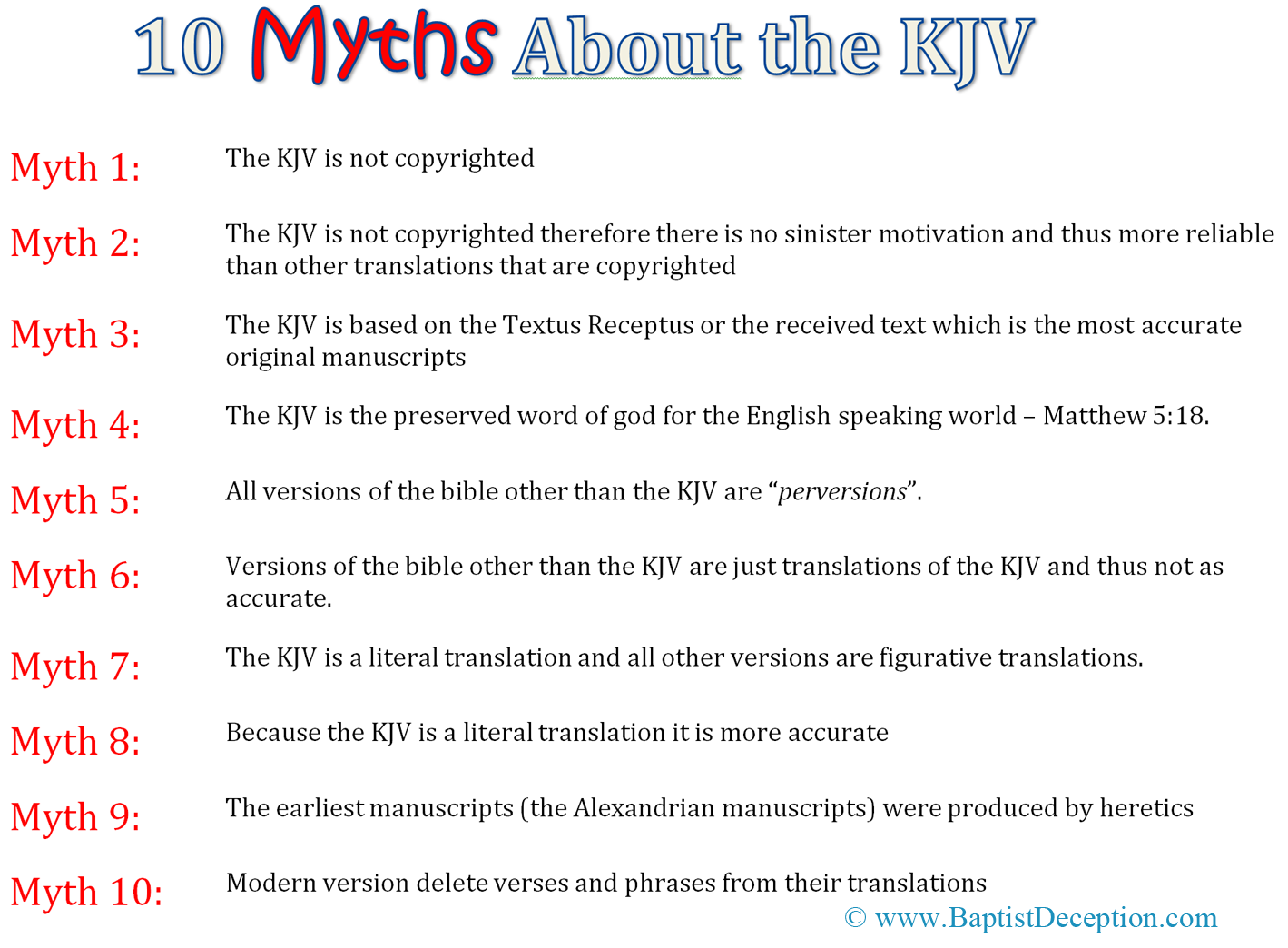
KJV Myths

Myth 1. The KJV is not copyrighted.

Actually this is partially true, but not completely. Technically in the US anything prior to 1922 is free of copyrights. This is simply because of the lack of copyright laws at that time. If that were the only issue then the KJV would not have a copyright. The problem, however, is that the KJV is not a work produced by an American citizen. The KJV is actually copyrighted under the Crown Copyright of England therefore the copyright of the KJV falls under the jurisdiction of England. Since the Crown Copyright is a perpetual copyright it will never end. The US has agreed to honor copyright laws of other countries. As a result the KJV is actually copyrighted here in the US as well. It is rarely enforced simply because of logistical issues – its just not practical. But the KJV is under copyright here in the US.

Myth 2. The KJV is not copyrighted therefore there is no sinister motivation and thus more reliable than other translations that are copyrighted.

First of all, even if the KJV weren’t copyrighted, which we established above that it indeed is, that doesn’t mean that there is no malicious intent for producing the KJV. As stated above, the KJV was actually rushed through production for political reasons rather than religious reasons. Secondly, not having a copyright doesn’t mean that it is more accurate or reliable. A copyright is nothing more than a legal issue that prevents the copying of a work. It is not an endorsement of perfection.

Myth 3. The KJV is based on the textus receptus or the Received Text which is the most accurate original manuscripts.

As noted above, the textus receptus is a family of manuscripts known as the Byzantine Family and were nothing more than a collection of copies of the original. It is a succession of printed Greek texts of the New Testament which constituted the translation base for the original German Luther Bible, for the translation of the New Testament into English by William Tyndale and eventually the King James Version.

The Byzantine manuscripts are far from the most accurate. Scholars generally agree that the Alexandrian manuscripts are much more accurate and reliable.

Myth 4. The KJV is the Preserved Word of God for the English speaking world – Matthew 5:18

The IFB use Matthew 5:18 to teach that the KJV is the “Preserved Word of God” because verse 18 reads: For verily I say unto you, Till heaven and earth pass, one jot or one tittle shall in no wise pass from the law, till all be fulfilled (KJV). I was taught growing up that this verse means that the Lord will preserve His Word in the form of the KJV. The message was that other versions of the Bible added or subtracted or changed things in the Word of God and since the Lord tells us that “one jot or one tittle shall in no wise pass from the law” then the KJV MUST be the only version we are to use.

This is completely false and nothing more than the twisting of scripture. First of all this verse is talking about the law, NOT versions of the Bible. Secondly, it isn’t our responsibility to preserve God’s Word. The Lord said that He would take care of that. Finally, as noted above, we know that the KJV has gone through many changes because of poor translations. Even if Matthew 5:18 did apply to Bible versions the KJV wouldn’t be the preserved version since it has errors.

Myth 5. All versions of the Bible other than the KJV are “perversions”

The IFB is infamous for using this silly little play on words. It’s nothing more than a straw man fallacy, however, and is little more than an attempt at manipulation. IFB leaders want you to think that you are reading a “perverted” form of God’s Word if you read from any version of the Bible than the KJV. Perverting the Word of God by translating it into forms other than the KJV is false and is not founded on Scripture. There is absolutely no Biblical basis for calling other translations “perversions”.

Myth 6. Versions of the Bible other than the KJV are just translations of the KJV and thus not as accurate.

The KJV New Testament (and all editions since Tyndale) was compiled primarily from the Byzantine family of manuscripts (AD 500 – 1000) frequently referred to as the Textus Receptus. Modern translations such as the NIV are compiled primarily from the Alexandrian Family of manuscripts which are believed to be closer to the original than the Textus Receptus manuscripts, which is why they have been chosen by the translators of the modern versions. As a result the exact opposite of this Myth is true. Some of the more modern translations are actually more accurate and reliable.

Myth 7. The KJV is a literal translation and all other versions are figurative translations.

The IFB taught me that since the KJV is a word-for-word or literal translation it is most accurate. The IFB believes that all other versions are just figurative translations or translations that capture the message/thought of the author rather than the actual words. Nothing could be further from the truth.

The KJV is not completely a literal translation. It is next to impossible to completely translate the Bible into English using only literal or word-for-word translation. We simply wouldn’t be able to understand it. The culture then had idioms just like we do today that would make it impossible to translate the text word-for-word. Also, there are several modern translations that are based on a literal or word-for-word methodology such as the NAS, RSV and the YLT. The KJV is not the only version that makes an attempt at literal translation.

Myth 8. Because the KJV is a literal translation it is more accurate.

This is simply false. As I’ve already explained, it is impossible to capture cultural idioms with a literal translation. Some of the text in other version that rely on thought-for-thought translation are more accurate than the KJV.

Myth 9. The earliest manuscripts (the Alexandrian manuscripts) were produced by heretics.

The only evidence that KJV advocates use to support this is that the Alexandrian manuscripts disagree with the Byzantine manuscripts and their view. It’s just a biased view based on their beliefs. There is absolutely no evidence to support this myth.

Myth 10. Modern version delete verses and phrases from their translations.

Actually the opposite is true. Scholars generally agree that the translators actually added passages and verses to earlier versions of the Bible including the KJV. Dr. Charles Taylor in Bible with Wholes reminds us that when translating and copying the Scriptures, the translators and copyists tended to add explanations rather than remove words. “This is because the words are considered Holy and therefore must never be removed (cf Rev 22:19), though adding words of explanation was often considered acceptable.” [4] Careful inspection of the verses claimed to be “missing” from modern translations will yield the conclusion that the missing verses were actually additions made by earlier translators to explain the previous verse. As a result we can rest assured that those “missing” verses were added earlier and later dropped when new, more accurate manuscripts became available.

Bibliography

  1. A Brief History of English Bible Translations by Dr. Laurence M. Vance.
  2. Based on an article found at: http://www.comereason.org/theo_issues/theo025.asp
  3. Smith, Wilbur M. The English Bible and its Development The Open Bible Thomas Nelson Pub. Nashville 1979 p.1251
  4. Why I Quote The NIV Bible by Graham Pockett
  5. A Response to the King James Only Debate by Eric Pement
  6. “The King James Version Debate: A Plea for Realism”, by D. A. Carson (Baker Book House, 1979)
  7. “Demystifying the Controversy Over the Textus Receptus and the King James Version of the Bible,” I.B.R.I. Research Report No. 3, by Douglas S. Chinn and Robert C. Newman (Biblical Theological Seminary, Hatfield, PA, 1979);
  8. “The Truth About the King James Version Controversy”, by Stewart Custer (Bob Jones University Press, 1981).
  9. Charles V Taylor “Bibles With Holes?”
  10. Bruce Metzger, The Text of the New Testament, p. 99
  11. Bruce M. Metzger, Bart D. Ehrman, “The Text Of The New Testament: Its Transmission, Corruption and Restoration”, Oxford University Press, 2005, p. 152
  12. T. Robertson, An Introduction to the Textual Criticism of the New Testament, Nashville: Broadman, 1925, pp. 107-108
  13. D. Whitby, Examen variantium Lectionum Johannis Milli, London 1709
  14. J. J. Griesbach, Novum Testamentum Graece, (London 1809)
  15. An Inquiry into the Integrity of the Greek Vulgate, or Received Text of the New Testament; in which the Greek Manuscripts are newly classed; the Integrity of the Authorised Text vindicated; and the Various Readings traced to their Origin (London, 1815), ch. 1. The sequel mentioned in the text is Nolan’s Supplement to an Inquiry into the Integrity of the Greek Vulgate, or Received Text of the New Testament; containing the Vindication of the Principles employed in its Defence (London, 1830)
  16. ibid., ch. 5
  17. Daniel Wallace, “Some Second Thoughts on the Majority Text”, Bibliotheca Sacra, July-September, 1989, p. 276

Related articles for download in .doc format:

A response to the King James Only Debate
Why so many Bible Translations


A response to Pastor Melton’s Questions for the KJV Critics.


A reader posted a comment with a link to Bible Baptist Church in Sharon, TN in which the author poses questions to Critics of the KJV. I would like to answer those questions in this post. They are below.

Before I begin, I think it’s important to bring to the reader’s attention that Pastor Melton is coming from the point of view that the KJV is a perfect translation which taints his entire perspective. The KJV is no more perfect then the other translations. One need not much more than common sense to understand that the KJV is a translation and was translation by imperfect human beings making it impossible for it to be a perfect translation. The idea that the KJV was inspired is ridiculous at best and heretical at worst.

Despite this obvious flaw in the thinking of KJV onlyists, I will try my best to answer the questions posed by Pastor Melton.

Enjoy!

1. Since you’re smart enough to find “mistakes” in the KJV, why don’t you correct them all and give us a perfect Bible?

First, only KJV advocated claim that there is a perfect Bible. Those who use other versions recognize that there is no such thing as a “perfect Bible”. This alone voids your assertion since critics of the KJV realize that a “perfect Bible” is impossible. Second, even if someone corrected all the mistakes in the KJV, a “perfect Bible” would still be impossible since we don’t have all the original documents. Third, being smart enough to find mistakes doesn’t necessarily constitute the knowledge to make a “perfect Bible”. Finally, this is essentially what the translators of the modern versions have done. They have corrected mistakes found in the KJV. Although they aren’t perfect they are certainly more accurate then the KJV.

2. Do you have a perfect Bible?

No. See answer to question 1

3. Since you do believe “the Bible” is our final authority in all matters of faith and practice, could you please show us where Jesus, Peter, James, Paul, or John ever practiced your terminology (“the Greek text says…the Hebrew text says….the originals say…a better rendering would be….older manuscripts read….” etc.)?

New Testament writers, especially Jesus and Paul frequently quoted from Old Testiment texts, especially from the prophets like Isaiah and Daniel. These text were written in Hebrew. Jesus quoted the original Hebrew text as many as 24 times during his ministry. See Luke 24:24 for an example.

This is really laughable. I will throw the same question back at you. Can you please show me in the Bible where Jesus, Peter, James, Paul or John ever practice YOUR terminology? Can you please show me in the Bible where Jesus, Peter, James, Paul or John ever quoted from the KJV? English wasn’t the language that Jesus, Peter, James, Paul or John spoke so that alone negates the idea that they quoted from the 1611 KJV.

I’ve sat under many KJV Only advocates who refer to the original language of the scriptures. This isn’t something that only advocates of modern versions do.

Anyway, logic dictates that Jesus, Peter, James, Paul and John made minimal reference to the original manuscripts because they weren’t available yet. There was nothing to refer to except the Old Testament so they couldn’t use terminology like “the Greek text says… older manuscripts read…” etc.

4. Since you do not profess to have a perfect Bible, why do you refer to it as “God’s word”?

For the same reason we refer to the KJV as “God’s Word” and at the same time declare it to be imperfect. It is God’s Word, the Bible. The true Word of God is the original documents. All others are translations, but we still refer to them as God’s Word.

5. Remembering that the Holy Spirit is the greatest Teacher (John 16:12-15; I John 2:27), who taught you that the King James Bible was not infallible, the Holy Spirit or man?

I could ask you the same question. Remembering that the Holy Spirit is the greatest Teacher (John 16:12-15; I John 2:27), who taught you that the King James Bible IS infallible, the Holy Spirit or man? I think that we would have the same answer.

6. Since you do believe in the degeneration of man and in the degeneration of the world system in general, why is it that you believe education has somehow “evolved” and that men are more qualified to translate God’s word today than in 1611?

It’s not about being more qualified and it has nothing to do with education. It’s about having more accurate original manuscripts and having better ways to study and translate those original manuscripts. Can you share what the difference is between the education/qualification of the translators of the 1611 KJV and the modern translations?

7. There is one true God, yet many false gods. There is one true Church, consisting of true born-again believers in Christ, yet there are many false churches. So why do you think it’s so wrong to teach that there is one true Bible, yet many false “bibles”?

I don’t think it is wrong to teach that there is one true Bible. I just think it is wrong to teach that the KJV is that one true Bible since it isn’t. There are many false Bibles. I don’t deny that.

8. Isn’t it true that you believe God inspired His holy words in the “originals,” but has since lost them, since no one has a perfect Bible today?

This is partially true. I don’t believe that the original manuscripts are “lost” since we do have parts of the original text, but we don’t have all the original texts so yes, it is true that no one has a perfect Bible today?

9. Isn’t it true that when you use the term “the Greek text” you are being deceitful and lying, since there are MANY Greek TEXTS (plural), rather than just one?

No this isn’t lying or deceitful. There is only ONE original Greek text. But just like today’s Bible is broken down into verses and chapters the original Greek Text is broken down into many different parts. We use the term Bible (singular) and Books of the Bible (plural). It’s really not that difficult to figure out.

This is a classic straw man fallacy. You are arguing semantics here and it really has nothing to do with translating the Bible.

10. Before the first new perversion was published in 1881 (the RV), the King James Bible was published, preached, and taught throughout the world. God blessed these efforts and hundreds of millions were saved. Today, with the many new translations on the market, very few are being saved. The great revivals are over. Who has gained the most from the new versions, God or Satan?

Your use of the word “perversion” shows your bias, but I will ignore that for now and ask, how do you know that very few are being saved? What a bold statement. I find it very hard to believe that you have the ability to know who is and who isn’t saved.

It’s a bit short sighted and closed minded to hand wave the many good things that have happened because of the newer, more modern translations and focus on the negative. Just because the great revivals are over (and I’m not sure they are) doesn’t mean that the modern translations are the cause.

Now let me ask you… if the KJV is the reason for the great revivals, why aren’t there still great revivals going on in churches that still use the KJV? Seems kind of strange to me that you would blame the lack of revivals on modern translations anyway. What a silly argument.

Lets say for argument’s sake that you are correct and revivals began to decline at the same time as the modern translations came on the scene. A first year philosophy student knows that correlation doesn’t equal causation.

Ultimately, I could, again, ask you the same question. Given the damage that dogmatic and inflexible proponents of the KJV have done to Christians and non-believers, who has gained the most from the KJV, Satan or God?


I hope my answers to those questions are satisfactory, although I doubt they will be. I would love for Pastor Melton to read this and let me know if he is satisfied with my answers. It would be great to have a debate. I’m not getting my hopes up though.


A response to Pastor Melton’s Reasons for Accepting the KJV as God’s Preserved Word.


On the same page Pastor Melton has written 10 “Reasons for Accepting the KJV as God’s Preserved Word” not of which hold water as I will show below with my responses to each reason.

1. God promised to preserve His words (Psa. 12:6-7; Mat. 24:35). There has to be a preserved copy of God’s pure words somewhere. If it isn’t the KJV, then what is it?

It’s important to make the distinction about what is meant by God’s “words”. This essentially has two meanings. In today’s Christian circles, “God’s Word” is typically taken to mean what we know of as the Bible or the “Word of God”. But God’s words can also mean his promises. I’m working under the assumption that Pastor Melton is making the argument that God’s words represent the Word of God or the Bible since that is the context in which he writes these things.

As such, this is a good example of where the KJV is wrong. When the Bible talks about God’s word – especially in the two passages that are mentioned in number 1 above – it is talking about literally God’s word or God’s promises, NOT the Bible as we know of it today. It’s similar to our phrase “you have my word on that”. It means God’s promises NOT the “Word of God” or the Bible. The bible wasn’t assembled, as it is for Christians today, during the times that those verses were written. We refer to the Bible as the “Word of God” but when those verses were written that phraseology wasn’t used so to interpret “God’s words” at the Bible or the Word of God is incorrect translation. (by the way the NLT among others properly translate those verses as God’s promises).

But lets say for argument’s sake that God did promised to preserve the “Word of God” (the Bible). God may have promised to preserve his Word, but he never told us how he would accomplish that promise. One thing is for sure, he did not promise to preserve his words by using only the KJV (if this is in the Bible somewhere I have yet to see it). To think that the KJV is the preserved Word of God simply because God promised to preserve his Word is nothing more than mere speculation and hearsay.

Psalm 12:6-7 is about God keeping his promises, it has nothing to do with the preservation of the Bible. Matthew 24:35 says that God’s words will never pass away not that God will preserve his word through the use of the KJV. You are taking those verses and twisting them so that they fit your agenda. You use of those verses to support your argument is manipulative at best and heretical at worst.

I will offer a challenge to anyone who want’s to accept it. If you can prove by using the Bible that God promised to preserve either the “Word of God”/the Bible or even God’s words/promises, by way of the KJV I will take this site offline and put up a site promoting KJV onlyism in it’s place.

2. It has no copyright. The text of the KJV may be reproduced by anyone for there is no copyright forbidding it’s duplication. This is not true with the modern perversions.

This is simply a lie. The KJV does have a copyright. See Myth 1 above.

3. The KJV produces good fruit (Mat. 7:17-20). No modern translation can compare to the KJV when it comes to producing good fruit. For nearly four hundred years, God has used the preaching and teaching of the KJV to bring hundreds of millions to Christ. Laodicean Christians might favor the new versions, but the Holy Spirit doesn’t.

Using this logic one would have to conclude that the Latin Vulgate translation should be the version to use since it was in wider use and for more than twice as long as the KJV. You use the KJV, no doubt, because you don’t understand the Latin Vulgate just as many use more modern translations because they don’t understand archaic English.

This is an “Appeal to Tradition” fallacy. Just because something is older or been in use for a longer duration doesn’t automatically make it more correct. That’s like saying President Bush has done more good in office then President Obama. Well of course that’s going to be true since President Bush was in office for 8 years and Obama has only been in office for 9 months (at the time of this writing). The KJV has been around longer then any other modern translation, therefore, yes, it would produce more “good fruit”, but that doesn’t necessarily make it better or more reliable.

Also, “good fruit” is a pretty subjective term. How do you define “good fruit”? One could just a easily say that God has used the preaching and teaching of modern translations including the Spanish KJV, French KJV, and others to bring hundreds of millions to Christ. See, it works both ways.

Also, how do YOU know what fruit the translations have produced? You aren’t omniscient so you can’t make that claim. Only God knows the “good fruit” of the different versions of the Bible. It is very possible that the versions of the Bible other then the KJV have produced much more “good fruit”. It isn’t our responsibility to keep track of the fruit anyway. That’s God’s business.

Finally, I’m wondering how you KNOW that the Holy Spirit doesn’t favor the new versions? That’s a pretty bold and, I must say, arrogant claim to knowledge that you don’t nor ever could possess.

4. The KJV was translated during the Philadelphia church period (Rev. 3:7-13). The modern versions begin to appear rather late on the scene as the lukewarm Laodicean period gets underway (Rev. 3:14-22), but the KJV was produced way back in 1611, just in time for the many great revivals (1700-1900). The Philadelphia church was the only church that did not receive a rebuke from the Lord Jesus Christ, and it was the only church that “kept” God’s word (Rev. 3:8).

Any first year philosophy student can tell you that correlation does not equal causation. Just because there is a correlation between the lukewarm Laodicean period and modern translations coming on the scene doesn’t mean that the cause is the modern translations. The same is true for the revivals. Just because there is a correlation between the time of the revivals and the KJV coming on the scene doesn’t mean that the KJV is responsible for the revivals.

Revelation 3:7-13 does not tell us that “the KJV was translated during the Philadelphia church period.” I don’t know why you referenced that passage. Your history is a bit off. Philadelphia was destroyed by an earthquake in A.D. 17, almost 1600 years before the translation of the KJV.

Also, Revelation 3:14-22 doesn’t tell us that “the modern versions begin to appear rather late on the scene as the lukewarm Laodicean period gets underway.” I’m not sure why you referenced that passage either. The modern versions arrived on the scene about 1500 years after the Laodicean period started. Are you making this stuff up or are you really that confused about the history?

Finally your gross misinterpretation of that passage in Revelation is your error and is extremely laughable. God was praising the Church in Philadelphia because they were obedient, not because they used the KJV. The correct interpretation is obedience NOT “kept”. The use of the word “kept” is confusing you. “Kept” does not mean that they refused to use translations other than the KJV.

5. The KJV translators were honest in their work. When the translators had to add certain words, largely due to idiom changes, they placed the added words in italics so we’d know the difference. This is not the case with many new translations.

This just a silly argument. You don’t KNOW that the KJV translators were completely honest in their work. This is an unfair argument because the KJV is a literal or word for word translation. Other translations are thought for thought translations. You’re comparing apples to oranges. Just because some modern translations don’t use the exact same distinctions as the KJV doesn’t mean they are less reliable.

6. All new translations compare themselves to the KJV. Isn’t it strange that the new versions never compare themselves to one another? For some strange reason they all line up against one Book–the A.V. 1611. I wonder why? Try Matthew 12:26.

Where do you get the idea that “all new translations compare themselves to the KJV”? I’ve never heard that before and I don’t believe it’s true. Do you have proof of this?

Lets say for the sake of argument, though, that that statement is true. There are many explanations for this. One could surmise that the reason is because people are deceived into thinking that the KJV is perfect and errorless by con artists like yourself and in order to promote the new translations the translators use the KJV as a basis for helping people understand that the KJV only arguments don’t hold water. It could also be simply because the KJV is so popular that the translators simply wish to show people that the new translations are just as good if not better then the KJV. It could also be so that when people make the transition from the KJV to another version the transition is easier and goes more smoothly. So no, it’s not strange at all that the new versions compare themselves to the KJV (if that’s even true).

Also, I’m not sure what Matthew 12:26 has to do with this argument. How do you get the idea that new versions of the Bible are bad because of Matthew 12:26? Jesus was answering the Pharisee’s accusations that he was getting his power to heal from Satan. He was explaining that Satan can’t cast out demons because it would hurt his cause. I would absolutely love to hear how you get an argument for using the KJV from that verse.

7. The KJV translators believed they were handling the very words of God (I Ths. 2:13). Just read the King James Dedicatory and compare it to the prefaces in the modern versions. Immediately, you will see a world of difference in the approach and attitude of the translators. Which group would YOU pick for translating a book?

This makes no sense to me. You’re saying that because the preface is better in the KJV it is more reliable and trustworthy? Weird. I’ve never heard anyone use that argument before. Couldn’t it be that the preface for the KJV sounds better because of the language used and the era in which it was written? This feels like you are grasping at straws.

Also, I’m not sure what 1Thessalonians 2:13 has to do with your argument. That verse does not say, or even hint to the idea, that “The KJV translators believed they were handling the very words of God”. Yet, another gross misinterpretation/manipulation of scripture. You should be ashamed.

8. The KJV is supported by far more evidence. Of over 5,300 pieces of manuscript evidence, ninety-five percent supports the King James Bible! The changes in the new versions are based on the remaining five percent of manuscripts, most of which are from Alexandria, Egypt. (There are only two lines of Bibles: the Devil’s line from Alexandria, and the Lord’s line from Antioch. We’ll deal with this later.)

This is simply a lie. I’m not sure where you are getting these facts from. Care to share your source or are you just making that up?

There are several things wrong this this argument. First, the original manuscripts aren’t based on the KJV. You’ve got is backwards. The KJV is based on the original manuscripts. This is another error based on your presumption that the KJV is the perfect, original Word of God.

Second, the Alexandrian family of manuscripts don’t represent “the remaining five percent” of the manuscripts that weren’t used by the translators of the KJV. The Alexandrian family of manuscripts are a completely different set of manuscripts then those used to translate the KJV.

Third, most scholars agree that the Alexandrian family of manuscripts are more complete and reliable (see article above).

Finally, calling The Alexandrian family of manuscripts “the Devil’s line” is nothing more than an ad hominem fallacy. It does nothing to prove your point except to attack the opposing view – unless of course you can provide evidence that the Devil was involved in this line of manuscripts. I would love to hear you explain this further.

This is laughable. What a crock.

9. No one has ever proven that the KJV is not God’s word. The 1611 should be considered innocent until proven guilty with a significant amount of genuine manuscript evidence.

There are several things wrong with this argument as well. First of all, if we must admit that no one has ever proven that the KJV is NOT God’s Word then you must also admit that no one has ever proven that the KJV IS God’s Word.

Secondly, innocent until proven guilty doesn’t apply here. We are searching for truth not justice.

Third, this is an “Appeal to Ignorance” fallacy. Lack of evidence or proof is not a good reason to conclude that the opposite is true. The KJV should be considered a fallible translation simply because it is a translation done by fallible humans not because no one has ever proven that it isn’t God’s Word.

Fourth, you are asking the impossible. No one could ever PROVE that the KJV isn’t God’s Word. Your standards are too high. Which leads me to see your bias. You are unwilling to consider the opposite side of the argument until the impossible happens, which of course never will.

Finally, there is evidence to indicate that the KJV is not THE perfect, infallible, original Word of God. To ignore the evidence for the sake of unattainable proof is nothing more than hand waving and bais.

10. The KJV exalts the Lord Jesus Christ. The true scriptures should testify of Jesus Christ (John 5:39). There is no book on this planet which exalts Christ higher than the King James Bible. In numerous places the new perversions attack the Deity of Christ, the Blood Atonement, the Resurrection, salvation by grace through faith, and the Second Coming. The true scriptures will TESTIFY of Jesus Christ, not ATTACK Him!

Where is your evidence of this? I have never read a translation that attacks the deity of Christ, the blood atonement, the resurrection, salvation by grace through faith, or the second coming. This is pure deception about modern translations. You are lying! There may be some minor differences in the various translations, but none of them make changes around core doctrine or absolutes of the faith.

Categories: KJV Onlyism Tags: